Addressing the systemic pressures facing modern India through rotational community tourism.
Relieving the systemic burden on mega-cities by creating economic "anchors" that allow youth to thrive in their ancestral homes.
Converting seasonal agricultural labor into year-round professional services through a structured rotational economy.
Halting the decay of traditional arts and ecosystems by making their preservation the core product of village tourism.
Meeting the exponential rise in global demand for "Slow Travel" and authentic, carbon-conscious human experiences.
No monopolies. Every week, a different family hosts, cooks, and guides, ensuring 100% community growth.
From bamboo rafting in our silent rivers to archery in the village square, we celebrate what nature gave us.
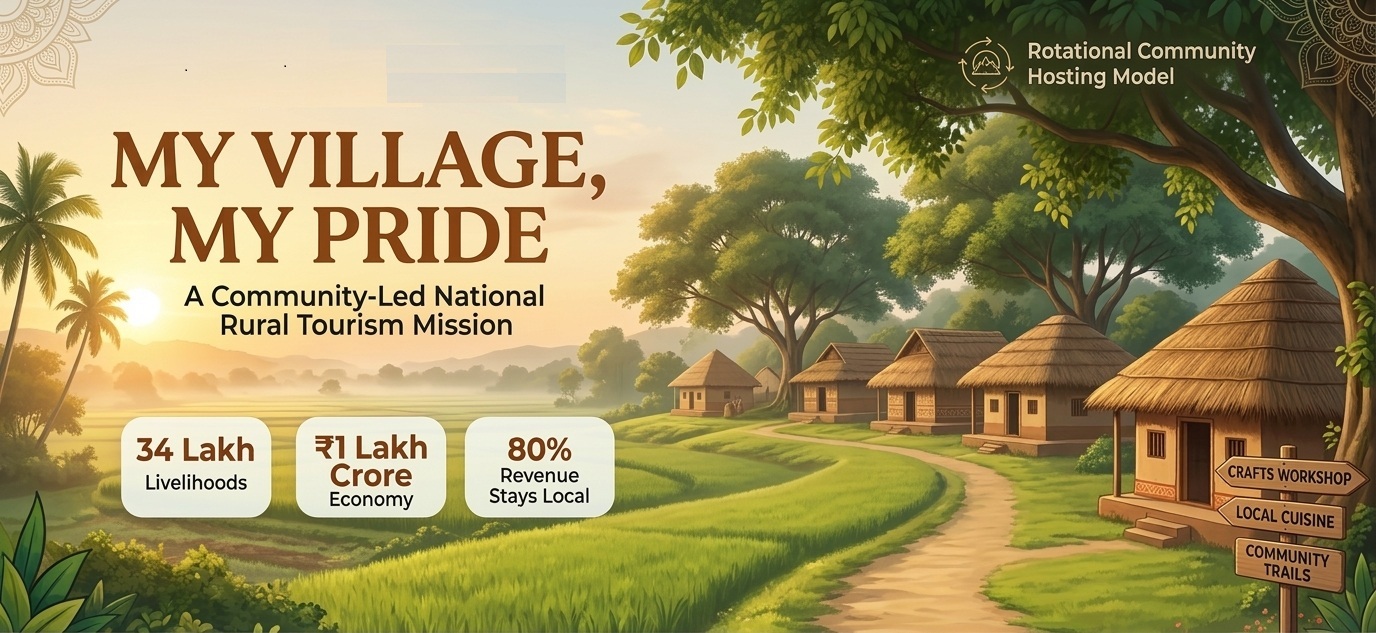
80% of your money stays here. No middlemen. Your visit builds our schools and protects our forests.
Our village operates as one. When you visit, you become part of a cycle of prosperity that prevents migration and revives our ancient sports and culture. Each stay is managed by a rotating committee of locals, ensuring the freshest food and the most authentic stories.
Our roadmap to revitalizing the rural landscape through structured tourism.
Creating long-term, dignified jobs within the village to stop forced migration.
Expanding India’s tourism map beyond the usual landmarks to hidden rural gems.
Empowering local governance by giving them the tools to manage tourism revenue.
Protecting traditional crafts and folklore by making them a source of village pride.
Turning highway pit-stops into economic engines for the villages lining them.
Improving safety through active, vigilant communities that welcome and guide guests.
A transparent, hierarchical framework ensuring accountability from the Center to the Village.
National Rural Tourism Mission (NRTM)
National Branding, International Promotion, Digital Platform & Data, National Quality Standards
Exclusively for global marketing, brand building, and digital infrastructure maintenance.
State Rural Tourism Authority (SRTA)
State Circuit Planning, Skill Development, Infrastructure Convergence, Quality Inspections
Prices set via Central-State coordination based on seasonality and local demand.
Coordination Committee (DTCC)
Chaired by the District Collector. Identifies eligible villages, manages land allocation, and ensures law enforcement/safety coordination.
Management Committee (VTMC)
Led by the Sarpanch, featuring SHG members, Youth, Women, Artisans, and Farmers.
Quantifying the impact of the "One Block, One Village" model across India.
Development Blocks
One tourism-enabled village per block serving as an economic anchor.
Participating Households
Assuming ~100 households per village engaged in the rotation.
Total Livelihoods
Combining direct jobs (16.5L) and indirect multiplier effects (17.5L).
| Metric | Estimated Value | Economic Impact |
|---|---|---|
| Avg Village Revenue | ₹75 Lakh / Year | Conservative estimate per village circuit. |
| National Gross Revenue | ₹49,500 Crore | Direct injection into the rural economy. |
| Local Multiplier (2.0x) | ₹1 Lakh Crore | Total circulation through food, transport & crafts. |
Infrastructure is established without privatizing ancestral land. Ownership remains with the community or government.
Empowering Gram Sabhas with real economic roles.
Direct leadership in service management.
Dignified local jobs to stop migration.
Traditional crafts as economic assets.
Active village nodes near highways create a "Social Monitoring Environment." Increased activity reduces crime in isolated areas and improves night-time safety perception for travelers while boosting roadside commerce.